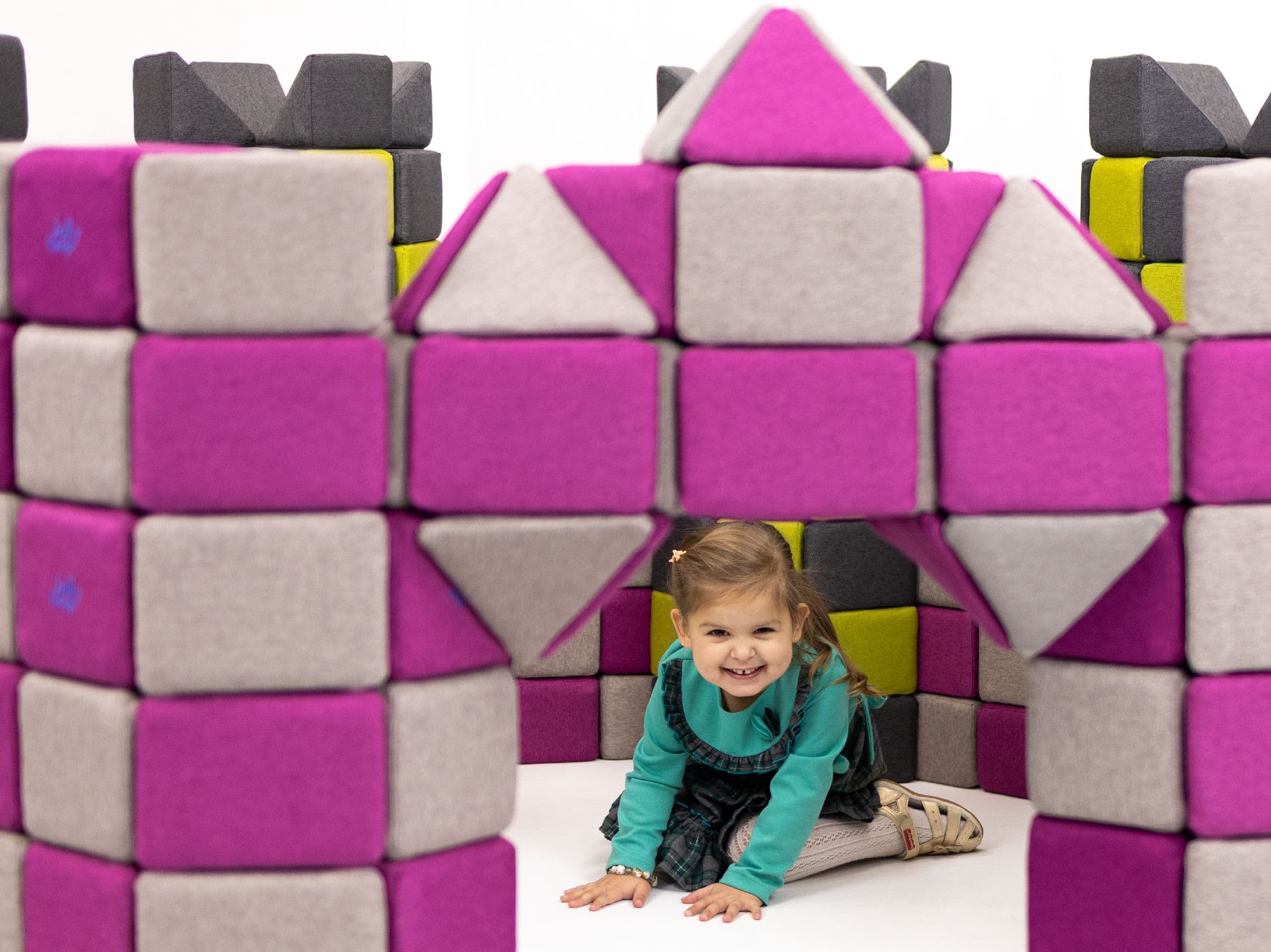
Nursery equipment · ages 1–3
A safe world of big discoveries
Create a space where toddlers develop movement, senses and relationships through safe play on a big scale. JollyHeap magnetic blocks are nursery equipment for children from 12 months: soft, light and with no sharp edges.
One set, unlimited possibilities
How will you use JollyHeap blocks today?Will it be an obstacle course?
JollyHeap blocks are what you need when working with children:
Obstacle course and balance path
A platform, a bridge and a ramp. The carer rebuilds the layout for the age and ability of the group.
Tunnel and crawling area
A soft surface for children who are still crawling and finding their feet.
Calm-down corner
A den, a tunnel or a dividing wall a child can retreat behind, away from stimuli.
Building and knocking down
A tower, a wall, a garage for a toy car. Children bring their own ideas to life.
Hand training
The 12 cm block is sized for a child’s hand. Joining and separating trains grip and pressure.
Equipment for a sensory-motor area
Movable foam blocks mark out a sensory-motor area in the nursery room. The carer sets it up for the session and packs the blocks away afterwards, so the area doesn’t take over the room for good.


Why do JollyHeap blocks work in a nursery?
An exceptionally safe environment for the development of the youngest children.
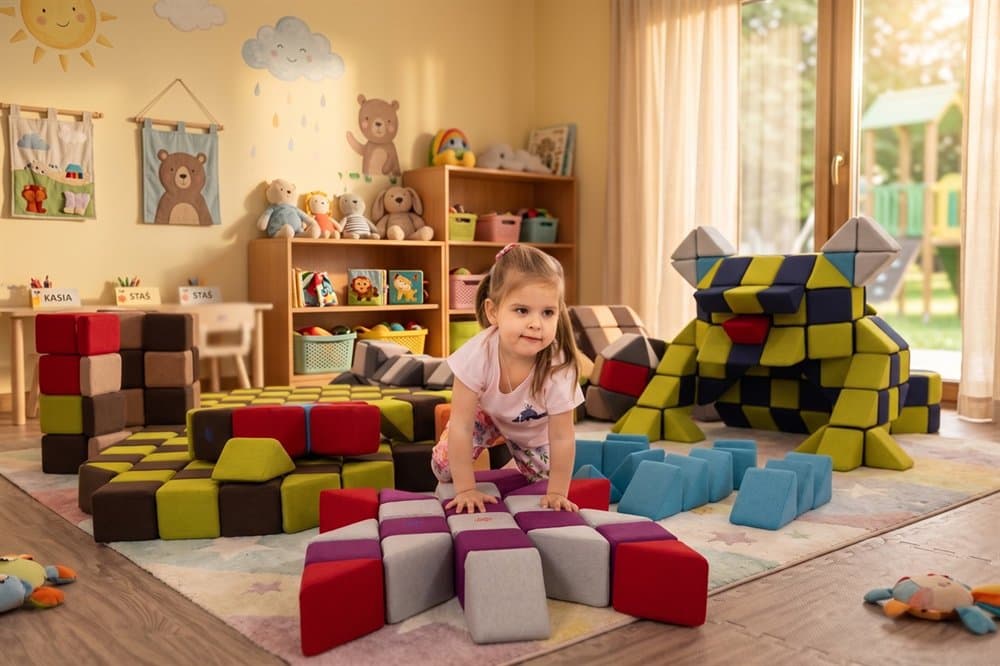
Movement without limits
The large format and light foam build strength, balance and coordination in a natural way.
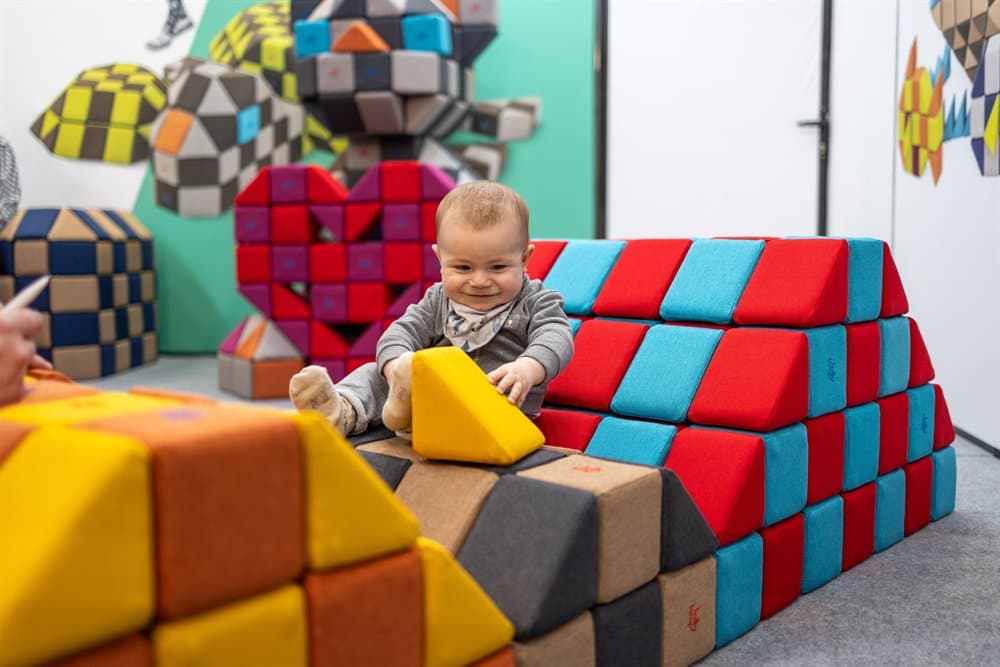
Rich sensory experience
Fabric with a distinct texture, springy foam and the gentle resistance of the magnets support sensory integration.
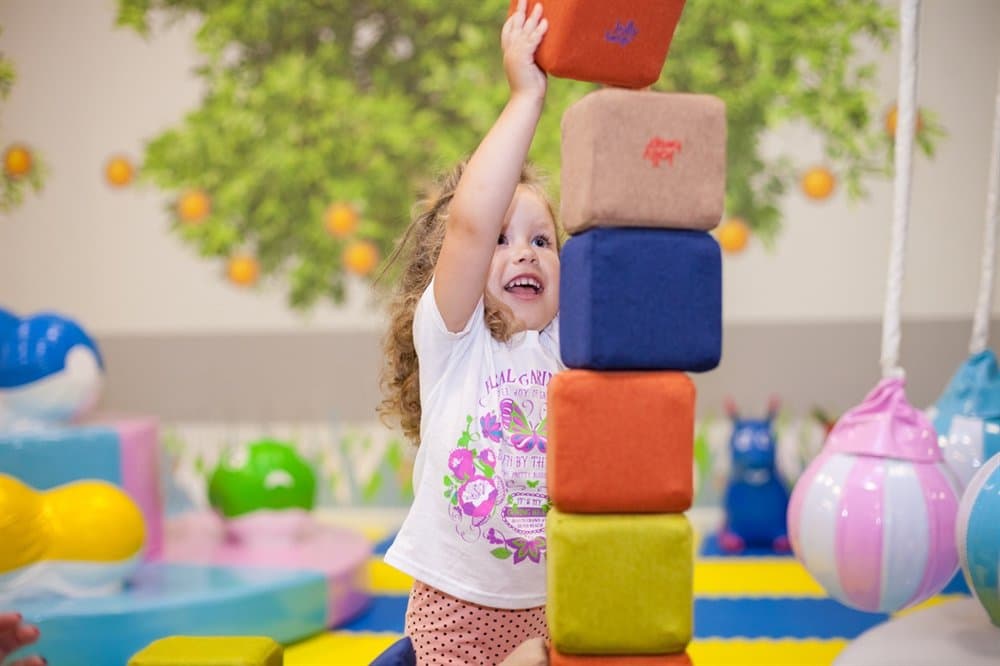
First successes without frustration
Strong magnets join the pieces easily, giving toddlers a sense of agency and independence.
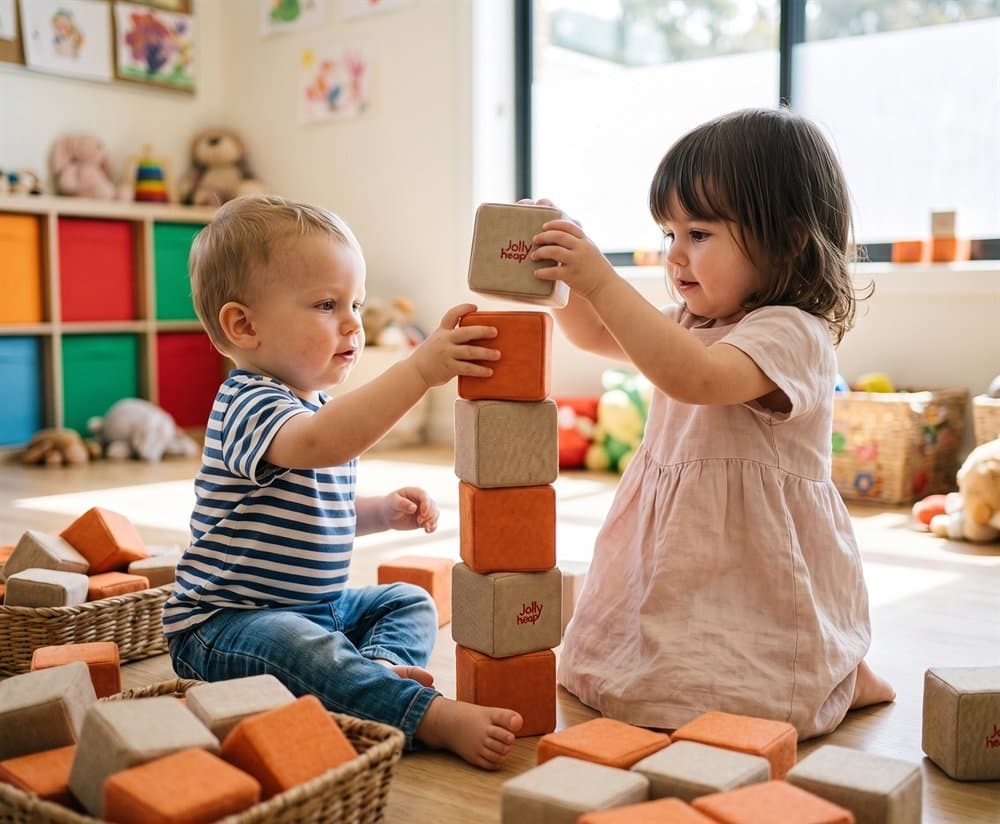
Building first bonds
Assembling structures together teaches children cooperation, sharing and communication in a group.

A sensory integration room in minutes
Why choose JollyHeap® blocks
Savings in budget and space
One JollyHeap set replaces a whole range of equipment and teaching aids. In minutes it turns from an obstacle course for learning to walk into a crawling mat, a calm-down corner or a soft place to rest after lunch.
Safety first
Quiet, soft blocks with no sharp edges protect against injury, and an X-ray of every single block before shipping rules out any foreign metal parts inside the structure.
Hygiene without extra staff work
Fresh stains come off with a wipe of a damp cloth. For heavier soiling the whole block goes into the washing machine at 30 °C.
Recommended sets for a nursery

Medium · 50 blocks
The entry point for equipping a nursery: 50 blocks for a small group.
€941incl. VAT, plus shipping

Basic · 100 blocks
The most popular choice. Enough for small obstacle courses, soft loungers and quiet hideouts.
€1,811incl. VAT, plus shipping
An investment that works for years
You buy one tool and use it in many ways. For years, with no electronics that break down, no plastic that snaps, and no tiny parts that get lost in no time.
Built to last
Six years in a playroom is just a warm-up. After six years in our showroom the blocks still looked good enough for a commercial photo shoot.
Service & warranty
3-year warranty, 10 years on the magnets, and after that we replace worn blocks at a preferential price.
Made in Poland
Producing a single block takes 6 people and 25 minutes of handwork.
How many blocks do you need?
Answer four quick questions for a tailored recommendation.
Get in touch
Questions or a custom order? We’ll get back to you fast.
Frequently asked questions
What nursery equipment develops movement in the youngest children?
Nursery equipment for active play has to be soft and light. Large soft magnetic blocks meet both conditions: the cube weighs 150 g and the pyramid 50 g, so a small child carries them unaided, climbs on them and crawls through a tunnel built from them. The Medium, Basic and Joy sets are intended for children from 12 months.
Are the blocks for one-year-olds, or rather for older children?
For both, just differently. The Medium, Basic and Joy sets are intended for children from 12 months. A one-year-old climbs, crawls and carries single blocks. A two-year-old stacks them and knocks them down with gusto. A three-year-old builds with intent and can tell you what is taking shape. The same set, three completely different kinds of play.
Are the blocks safe for children under three?
Yes. They bear the CE marking and meet EN 71-1, EN 71-2 and EN 71-3, the full set of toy safety standards. They have no sharp edges or hard parts on the outside, and the magnet is sealed deep inside, surrounded by foam and reinforced fabric. Every single block is X-rayed before shipping.
Aren’t the magnets too strong for the youngest children?
No. The attraction is tuned for exactly this age. A child joins the blocks effortlessly and has to try a little to pull them apart. That is a good thing: the resistance strengthens the hands and provides deep-pressure input. It is not so strong that it would put a two-year-old off.
How do we keep things clean around such young children?
Day to day, vacuuming or a wipe with a damp cloth is enough. For heavier soiling the whole block is machine washed at 30 °C, no more than 6 blocks of the same colour at a time, without removing the cover.
Aren’t the blocks too colourful for a sensory room?
They don’t have to be. Guidance for sensory-motor rooms calls for neutral, muted colours, including the equipment children can reach. We have 42 colour combinations, so we will put together a calm set. We have already done exactly that for a nursery that bought the blocks for such a room.
How much noise really goes away?
Our own testing shows that at twenty blocks per square metre the perceived noise in a room drops by up to 30 percent. The result depends on the size of the room and how the blocks are arranged, so treat the figure as an order of magnitude. The biggest difference is heard when a structure falls, because there is simply no crash.