· 5 min read
Development toys in early childhood education: what to choose and why
A toy that teaches is not a toy with a label saying so. What actually makes the difference in a nursery or preschool room, which categories earn their place, and eight rules for choosing without wasting the budget

The first years set the shape of everything after them: how a child thinks, how they get along with others, and how they handle frustration. Most of that work happens through play, which is why the choice of what is in the room is a pedagogical decision rather than a purchasing one.
A “development toy” is not a toy with a label saying so. It is a toy that gives the child a problem to solve, room to solve it in more than one way, and a reason to come back to it next week.
What early education is really building
Thinking
Sorting, matching, counting, noticing a pattern: the earliest cognitive work is physical. Children arrive at abstract ideas by handling concrete things first, and the quality of what they handle affects how quickly they get there.
Social skills
A room of children is a permanent negotiation: who goes first, whose turn it is, what the rules are today. Sharing and cooperating are learned in that friction, not in an explanation about sharing.
Emotional growth
Play is where a child meets manageable frustration (the tower falls, the piece does not fit, someone else got there first) and learns that the feeling passes. This is difficult to arrange deliberately and easy to provide by giving children something genuinely challenging.
How toys support learning
Cognitive skills. A good toy asks a question. What fits where, what holds, what happens next. Children answer by trying, and answers arrived at that way stay.
Motor skills. Grasping, stacking, balancing, carrying: fine motor control for small pieces, gross motor for large ones. Both matter, and a room usually has plenty of the first and too little of the second.
Problem-solving. Trial and error is the mechanism. A child who builds a tower too tall and watches it fall has learned something about balance that no explanation delivers.
Categories that earn their place
Building blocks and construction sets
They look simple and do more work than anything else in the room.
- Spatial awareness. Handling blocks teaches size, shape and spatial relations, the groundwork for mathematical thinking later on.
- Motor skills. Grasping, stacking and balancing demand coordination and precision, the same kind that handwriting will need.
- Problem-solving. Cause and effect, balance, stability: learned by testing, including by knocking the tower over on purpose.
- Imagination. Blocks are not only towers. They become castles, ships, whole cities, and the child supplies the story.
Puzzles and educational games
- Cognition. Recognising patterns, colours and shapes trains memory and information processing.
- Attention. Finishing a puzzle requires staying with something, a skill formal schooling assumes and rarely teaches.
- Social skills. Multiplayer games teach turn-taking and working towards a shared goal.
- Emotions. Winning builds confidence; losing well is the harder and more useful lesson.
Craft materials
- Self-expression. Art gives children a way to put thoughts and feelings outside themselves, which matters for emotional development.
- Hand-eye coordination. Threading a bead, cutting along a line: precision work in small doses.
- Resourceful thinking. A limited set of materials forces invention. Constraint is the point, not a shortcoming.
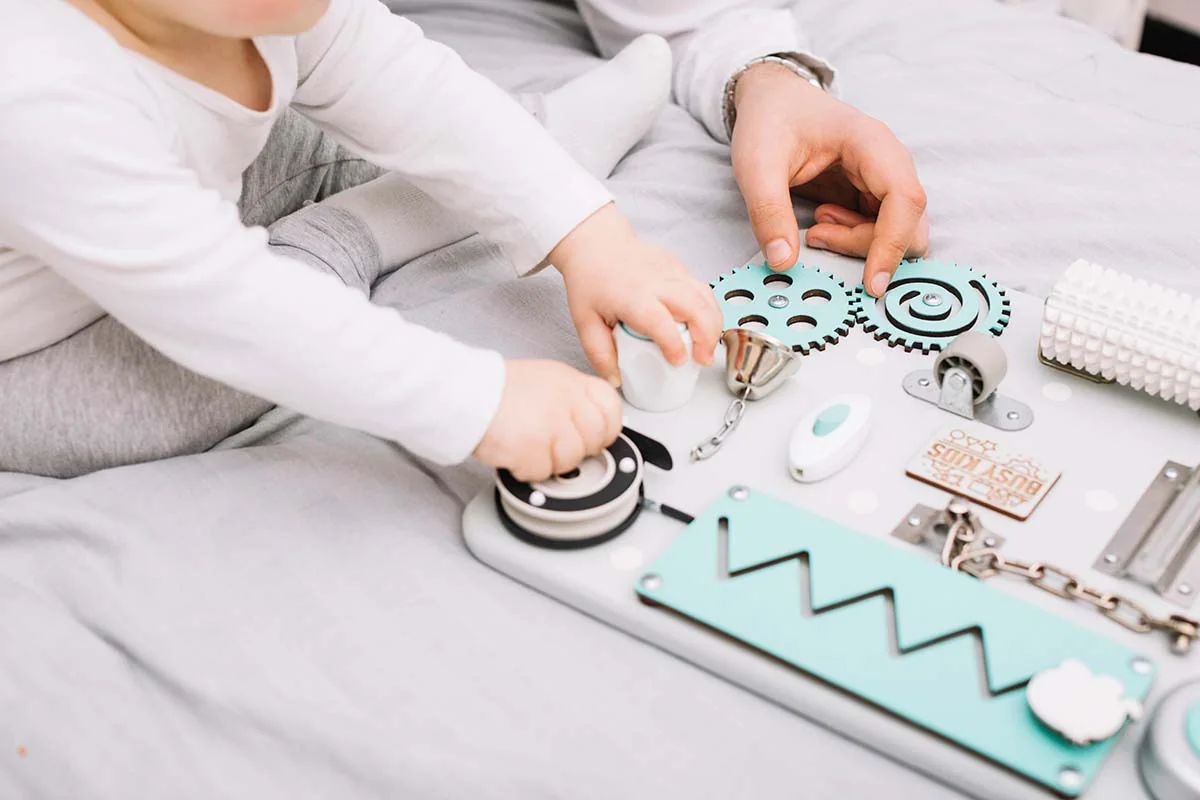
Eight rules for choosing
- Match the developmental stage, not the age on the box. Consider what the child is working on right now.
- Decide which skill you are buying. Fine motor control, cognition, cooperation. A toy that is meant to do everything usually does nothing well.
- Safety and durability first. Non-toxic materials, construction that survives enthusiasm, no small parts for the youngest children.
- Prefer open-ended. Blocks, art materials, puppets: anything that does not prescribe how it must be used.
- Look for versatility. A good set is a puzzle for a two-year-old and a construction project for a five-year-old. It stays in the room for years rather than months.
- Provide for both solitary and shared play. One builds concentration, the other builds cooperation. A room needs both.
- Choose quality over quantity. Fewer well-chosen things beat a full shelf. Too much choice overwhelms rather than enriches.
- Think about who has to tidy it up. A set that takes twenty minutes to put away will quietly stop being used.
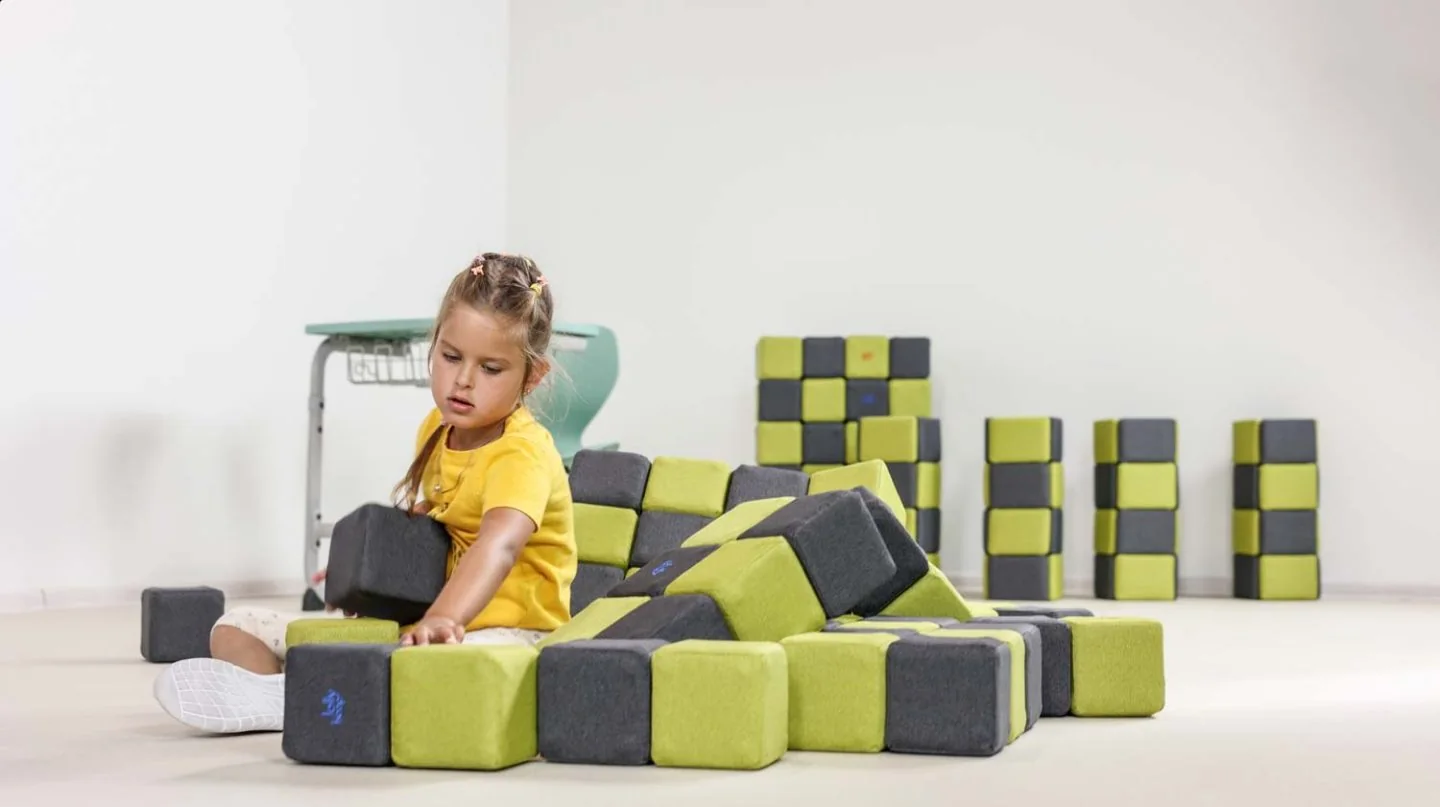
Where soft blocks fit
Large soft blocks answer several of these rules at once: open-ended, versatile across ages, safe by construction, and quick to clear because they stack. In a room where floor space is contested, one set that becomes a wall, a tunnel, a step and a quiet corner is worth more than four pieces of equipment that each do one thing.
See the sets or look at what other rooms build with them.
In short
Development toys matter in early education because they are the tools children use to reach the milestones everything else depends on. The selection principle is simple enough to hold in your head while standing in front of a catalogue: fewer things, more open-ended, and chosen for a skill you can name.