· 7 min read
Sensory Integration Therapy: what it is and who it helps
Some children are overwhelmed by the seam of a T-shirt and unmoved by a slammed door. Sensory Integration Therapy teaches the brain to organise what the senses bring in. Here is how it works and where it helps

Have you ever noticed that some children are highly sensitive to the texture of their clothes, react intensely to loud noises, or seem uncoordinated in their movements? These observations might be more than mere quirks. They could be signs of sensory processing issues, where the brain has trouble receiving and responding to information through the senses. It is not always easy for these children to navigate the world around them, but there is a special kind of support available: Sensory Integration Therapy.
Sensory Integration Therapy is a form of occupational therapy designed specifically to help children who struggle with sensory processing. Think of it as a method to help the brain get better at receiving, organising and responding to sensory information. For many families it changes daily life: the child interacts more effectively with the environment, and challenges that once seemed overwhelming become manageable.
The strength of Sensory Integration Therapy lies in its tailored approach. It is not a one-size-fits-all method. Each child’s sensory needs are assessed, and activities are chosen to target their individual challenges. Whether it is swinging, spinning, or tactile play with different textures, these seemingly simple tasks are carefully designed to help the brain make sense of sensory information.
What is even more striking is how far the effects reach. While the focus is on sensory processing, the benefits often extend into motor skills, behaviour and social interaction. It is about giving children the tools to feel more in control of their senses and, by extension, of their world.
Understanding Sensory Integration Therapy
What is Sensory Integration Therapy?
Sensory Integration Therapy is a specialised form of occupational therapy designed to help children who struggle with sensory processing. Its essence lies in helping children organise and interpret sensory information from their environment: the sights, sounds, textures, tastes and movements that most of us process without a second thought.
The therapy usually takes the form of structured, playful activities in a sensory-rich environment, tailored to each child. These range from swinging and balancing to tactile play with different textures. The goal is to challenge the child’s ability to respond appropriately to sensory input by gradually adjusting the complexity and type of stimulation. Over time, this makes sensory processing more efficient.
Who can benefit from it?
The therapy is aimed primarily at children who have difficulty processing sensory input: children with sensory processing disorder (SPD), autism spectrum disorder (ASD), ADHD, and other developmental conditions that affect sensory processing. Children who are overly sensitive to stimuli, under-responsive, or who seek out sensory experiences in unconventional ways can all benefit. It is designed to meet each child at their level of need, helping them cope with the sensory side of everyday environments: the classroom, the playground, the home.
Benefits of Sensory Integration Therapy
Improved sensory processing
The most significant benefit is better sensory processing itself. Through activities that progressively adapt to the child’s responses, children learn to process and react to sensory information more effectively. This shows up as decreased sensitivity to textures or sounds, better focus amid distractions, and a greater capacity for activities that coordinate movement and the senses.
Better performance at school
As children become more adept at processing sensory input, school performance often improves. Many classroom difficulties (staying focused during a lesson, handwriting, interacting with peers) trace back to underlying sensory processing issues. Therapy builds focus, organisation and motor skills, all of which are critical for learning. Parents and teachers frequently observe positive change in participation, behaviour and overall achievement.
Better emotional regulation
Children with sensory processing difficulties can experience real distress in overwhelming environments. Therapy helps them develop coping mechanisms and manage their responses to stimuli. Better emotional regulation means fewer meltdowns, fewer tantrums and less anxiety, and with them a better quality of life for the child and the family. Children often show increased self-confidence and stronger social skills, because they can take part in more activities and settings without becoming overwhelmed.
Common techniques
Sensory Integration Therapy is a toolbox of strategies that help the nervous system respond more effectively to sensory input. Here are the ones you will meet most often.
Deep pressure massage
Imagine the calming feeling of a tight hug: that is essentially what deep pressure massage does. Firm, hands-on pressure provides proprioceptive input, which has a calming effect on the nervous system. It tells the brain that it is safe to relax. This can be particularly helpful for children who are oversensitive to touch, or for those who are constantly on the move and find it hard to sit still.
Therapeutic brushing
Therapeutic brushing, or the Wilbarger Brushing Protocol, uses a specific soft-bristled brush on the child’s skin, followed by joint compressions. The technique aims to desensitise the sensory system of children who are overly sensitive to input. It is a way of letting the sensory system start fresh and process input in a more organised way. The protocol is strict: use it only after instruction from a therapist.
A sensory diet
A sensory diet is a planned set of activities tailored to a child’s specific sensory needs. Just as a nutritional diet balances what a child eats, a sensory diet balances sensory activities across the day to keep the child feeling “just right”. It might include jumping on a trampoline, chewing on a chewy toy, or quiet time in a dimly lit space, depending on whether the child needs to ramp up or calm down.
Sensory integration at home
Bringing these strategies home supports sensory health every day. It does not require a therapy room.
Incorporating sensory activities
- Schedule regular breaks. Short, sensory-focused breaks help. Jumping on a mini-trampoline before homework can improve focus and attention.
- Involve the child. Let them have a say in which activities happen. It makes them feel heard and more willing to take part.
- Keep it simple. Carrying groceries, pushing a laundry basket or kneading dough all provide valuable sensory input.
Creating a sensory-friendly environment
Start by observing what soothes and what agitates your child, then make small adjustments:
- Reduce overwhelming stimuli. If bright lights or loud noises are a problem, use softer lighting and provide quiet zones or noise-limiting headphones.
- Designate a sensory space. A small area to relax and regroup: bean bag chairs, weighted blankets, sensory bins.
- Embrace natural elements. Water, sand and potted plants provide calming sensory experiences. A small indoor fountain or a sandbox can become a therapeutic tool.

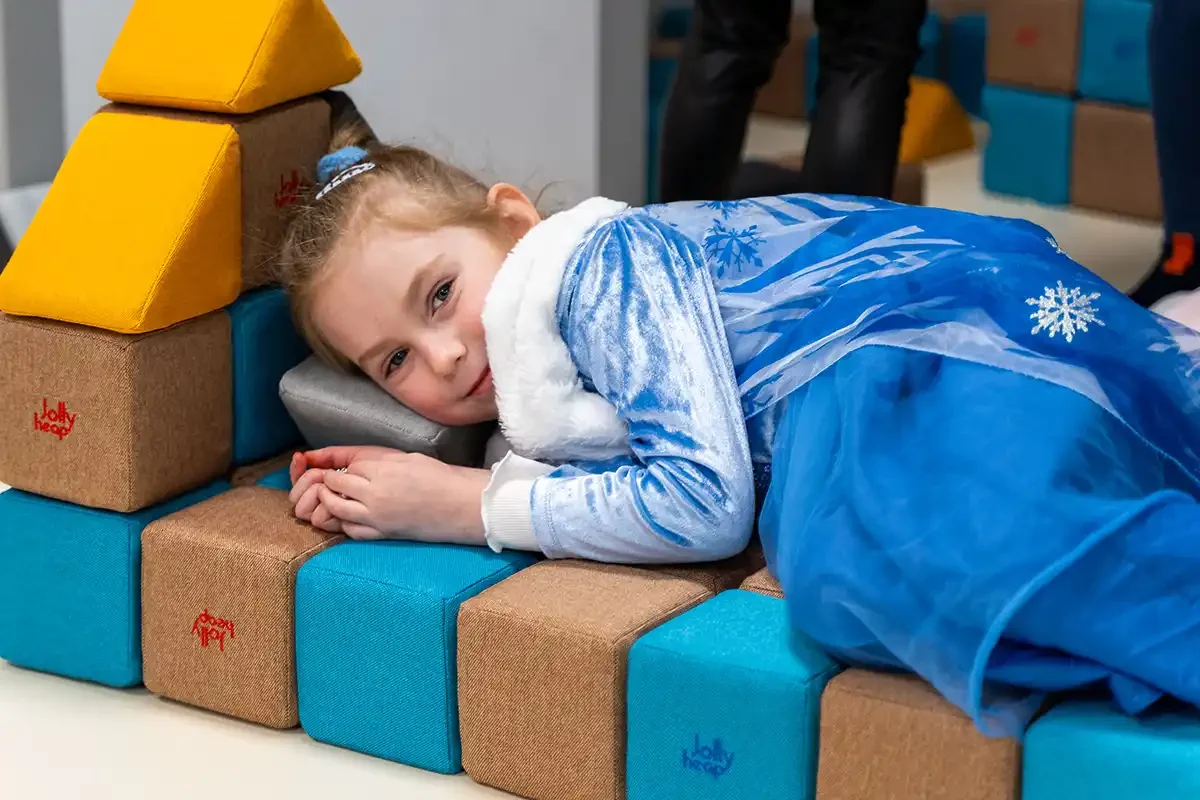
JollyHeap blocks work as a multifunctional tool in SI therapy: a roller, a platform, an obstacle course, a quiet corner. See the sets or read how to use them in therapy.
Making the most of the therapy
Set realistic goals
Start with clear, attainable goals. Understand the child’s needs and challenges, then define specific, measurable objectives. If a child struggles with tactile sensitivity, the goal might be to gradually increase tolerance for different textures. Targeted goals give the therapy direction and make progress visible.
Talk to the therapist
Effective communication with the therapist matters as much as the sessions themselves. Discuss the child’s routines, preferences, dislikes, and any subtle changes you notice. Ongoing dialogue keeps the therapy matched to the child’s evolving needs, and makes parents and therapists a team rather than two separate parties.
Monitor progress
Keep a progress journal, set regular check-ins with the therapist, and note changes in behaviour, skills and comfort levels. Monitoring validates what is working and shows where the plan needs adjusting. Celebrating small victories boosts the child’s confidence and keeps motivation up.
In short
Sensory Integration Therapy is a specialised approach for children who struggle with sensory processing. By focusing on individual needs, it helps them interact more effectively with their environment, which in turn supports learning and social life. The benefits (better coordination, longer attention spans, greater self-confidence) can shape a child’s whole developmental trajectory.
For families considering it, the first step is a trained and experienced therapist who can tailor a programme to your child. It can be a transformative step in supporting your child’s growth and well-being.