· 5 min read
10 benefits of soft play for toddlers
A soft play area looks like an hour of fun and works like a development session. What a toddler actually practises between the foam blocks: ten effects worth knowing before you plan the room

A soft play area (foam shapes, slides, tunnels, everything padded) looks like a place to burn off energy on a rainy afternoon. It is that. It is also, quietly, one of the more efficient development environments a small child can be given, because everything that happens there happens through the child’s own body and the child’s own decisions.
Below: ten things a toddler actually practises in a soft play area. Useful if you are choosing a venue, and more useful if you are planning one.
1. Sensory development
Soft play is dense with sensory input. Smooth slides, squishy foam, different resistances underfoot: all of it feeds the sense of touch. Strong colours and varied shapes work on vision and on visual-spatial awareness. And every climb, roll and drop trains the vestibular and proprioceptive systems: balance, and the sense of where the body is in space. For a two-year-old this is not a side effect. It is the main course.
2. Motor skills
Tunnels to crawl through, steps to climb, room to run: the structure of the space keeps proposing new ways to move. That variety builds gross motor skills (running, jumping, climbing) and fine motor skills at the same time, because grasping edges, gripping handles and manipulating smaller pieces are part of the same session.
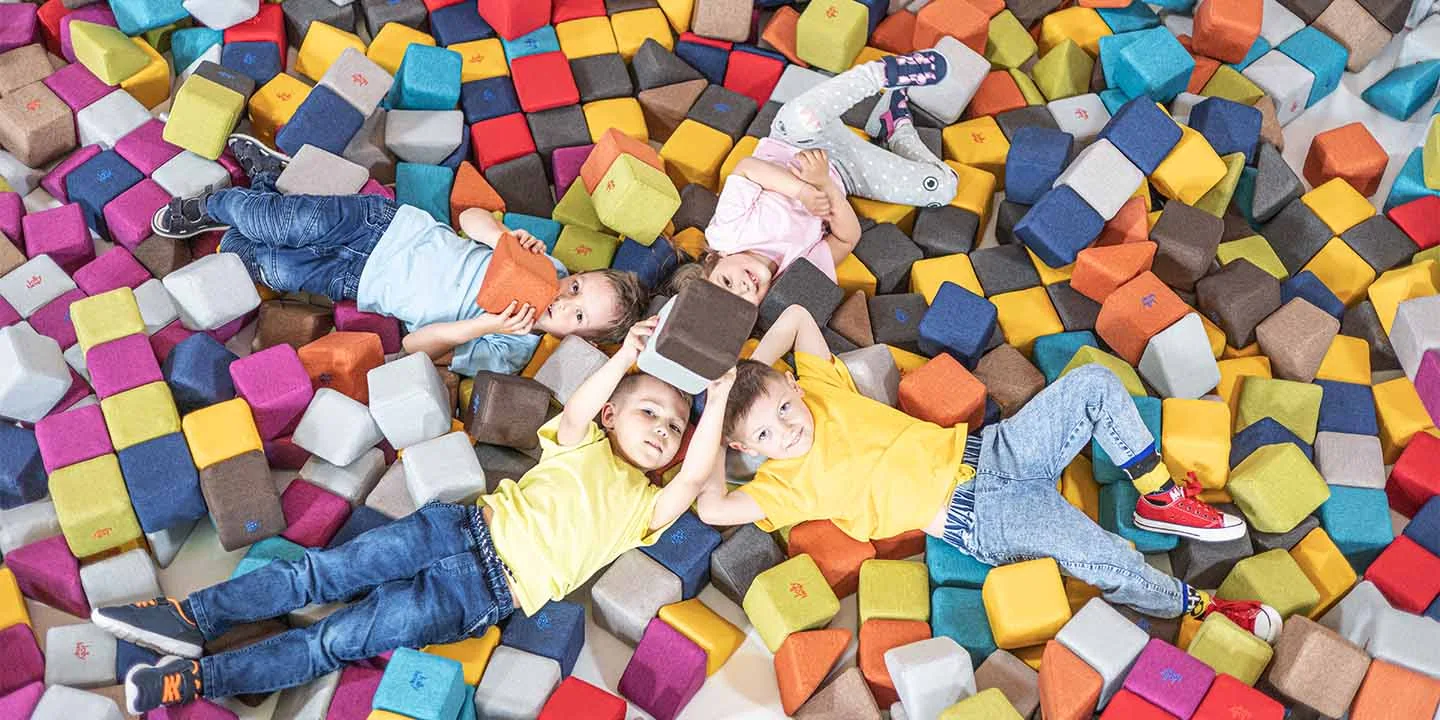
3. Social skills
A soft play area is rarely empty, and that is the point. Sharing equipment, waiting for a turn, agreeing who goes first: these are practised here in the only way they can be practised, which is with other children and with something at stake. Empathy and cooperation are learned in negotiation, not in explanation.
4. Cognitive development
Working out how to get through a structure, or how to climb something that was not obviously climbable, is problem-solving in its earliest form. Cause and effect is everywhere: push this and it moves, lean too far and you land. A child collects these rules by testing them, which is why they stick.
5. Emotional regulation
Soft play offers a controlled environment with real, small frustrations. A ladder that is a bit too high, a step that does not work on the first attempt. Meeting a setback and getting past it is how a child learns what frustration feels like and that it passes. This is difficult to teach any other way.
6. Physical activity
Running, climbing and jumping are cardiovascular work, and children get less of it than they used to. A soft play area makes movement the default rather than something that has to be organised. That is exactly why it works with children who resist organised exercise.
7. Imagination
Structures that can be read as a castle, a ship or a cave give the child something to build a story on. Pretend play is not a break from development; it is where language, sequencing and perspective-taking get practised at once. An open, reconfigurable set does this better than a themed structure, because it leaves the theme to the child.
8. Judging risk
Children need to test their limits, and they will do it somewhere. A padded environment lets them do it where the cost of misjudging is a soft landing. Climbing something slightly taller, jumping from slightly higher: these are calculated risks, and taking them is how a child builds an accurate sense of what their body can do. Caution that comes from experience is more reliable than caution that comes from being told.
9. Language
The social side of soft play pushes children to talk: to divide up equipment, to propose a game, to object to a rule. Vocabulary grows fastest in the company of other children, because there is a reason to use it.
10. Time with the adult
Soft play is one of the few settings where an adult can be present without directing. Joining in, or simply being there while the child plays, strengthens the relationship, and it gives the adult a rare, uninterrupted look at how the child moves, solves problems and handles a setback.
What this means when you are planning a room
The ten effects above come from the environment, not from a particular piece of equipment. Practically, that means:
- Variety of movement beats quantity of equipment. Something to climb, something to crawl through, something to jump onto, room to run. Four functions in a small space are worth more than one large structure.
- Reconfigurable beats fixed. A set that children can rebuild keeps producing new problems to solve. A fixed structure is solved once.
- Soft everywhere, not just underfoot. Padding on the floor protects falls. Padding on the elements themselves is what lets a child take the risk in the first place.
We make JollyHeap blocks with this in mind: light enough for a child to carry, big enough to build with, soft on every edge, and held together by magnets so a wall becomes a tunnel becomes a step. See the sets, or look at what other people build with them.